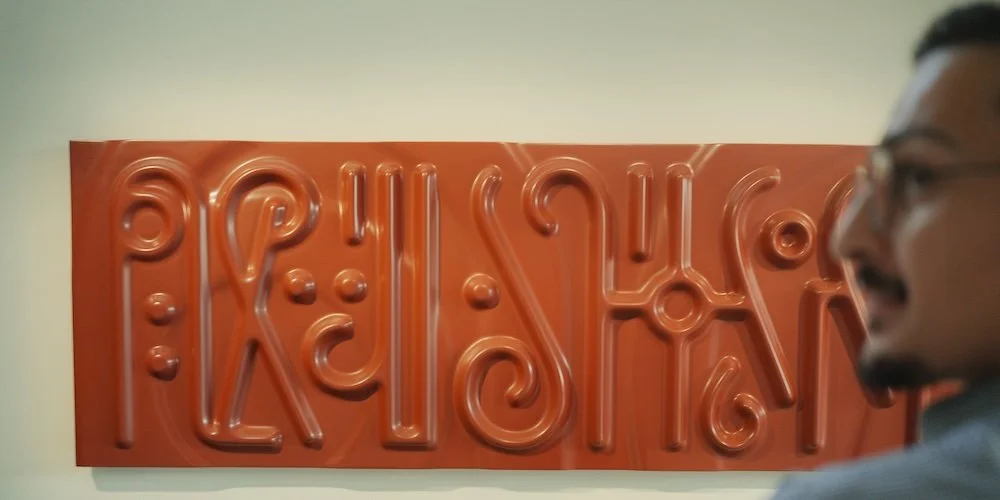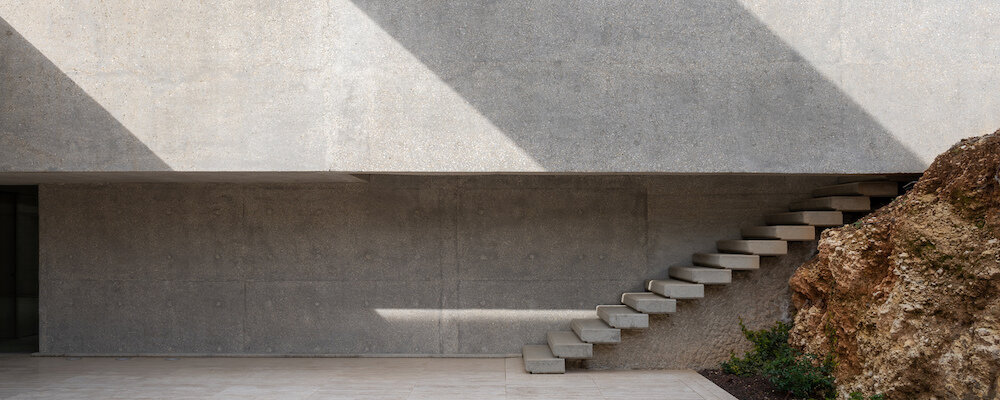
Amman, Accumulated: The Return of Amman Design Week
After seven years of silence, Jordan’s design week has reopened under new directors Bisher Tabbaa and Sarah Hejazin and curators Faysal Tabbarah and Khaled Al-Bashir, with a theme that fits its long pause.
Some cities announce their creative ambitions with a skyline. Amman has always done it more quietly, in stone courtyards, workshops and small studios up steep stairways. For three editions, Amman Design Week turned those quiet places into one of the most thoughtful platforms on the regional calendar. Then it went dormant. So I will say it plainly: I am delighted it is back.
I have long thought the first three editions were among the most original design events in the Middle East. Each had a clear idea behind it: Huna Al Tasmeem (This is Design) in 2016, Design Moves Life Moves Design in 2017, and Possibilities in 2019. The talks asked real questions, and the work on show was rooted in its place rather than made for export. Across those three editions the event drew 89,000 visitors, more than 160 exhibitors and 52 participating spaces. That is a remarkable record for a festival that never charged for entry. Its founding directors, Rana Beiruti and Abeer Seikaly, set a high bar.
Two directors, two curators
The fourth edition is led by a team of four. The co-directors are Bisher Tabbaa and Sarah Hejazin, architects and co-founders of the Amman studio FADAA. They know the event from the inside. Tabbaa showed his Earth Chair at the 2019 edition, and Hejazin was on Arini’s curatorial team for the Kabariti Village. Leaders who once exhibited in the festival are now running it, which is exactly the kind of continuity a design ecosystem needs.
With them are two curators: Faysal Tabbarah for the exhibitions and Khaled Al-Bashir for the public programmes. Tabbarah was born in Aleppo and is an Associate Professor at the American University of Sharjah’s College of Architecture, Art and Design and at the Carleton University, Ottawa. Al-Bashir directs arts and culture at Darat al Funun – The Khalid Shoman Foundation and trained at the Architectural Association in London. Tabbarah brings architectural experimentation and material research; Al-Bashir brings cultural enquiry and a sense of how ideas reach a public. The directors describe the exhibitions and programmes as complementary while each keeping its own identity.
Accumulations
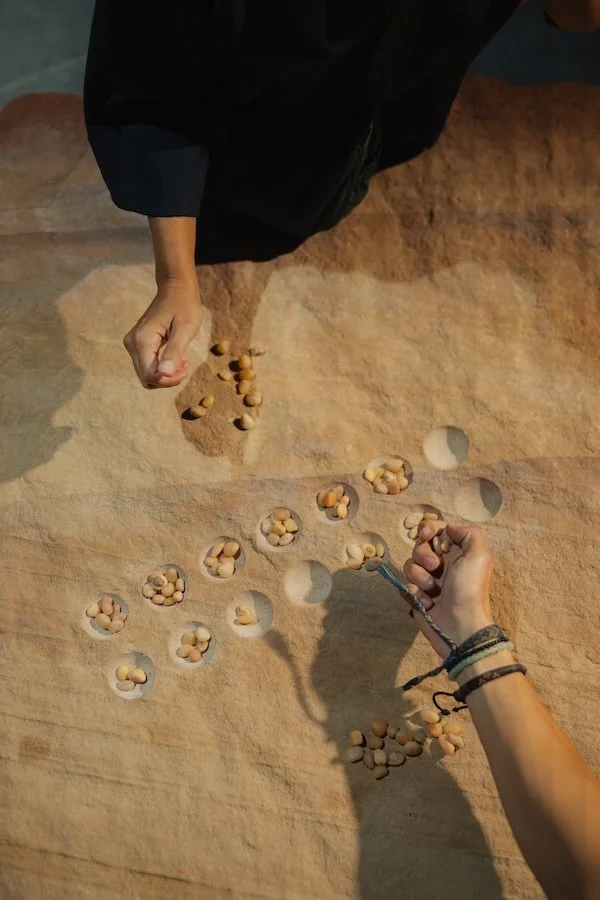
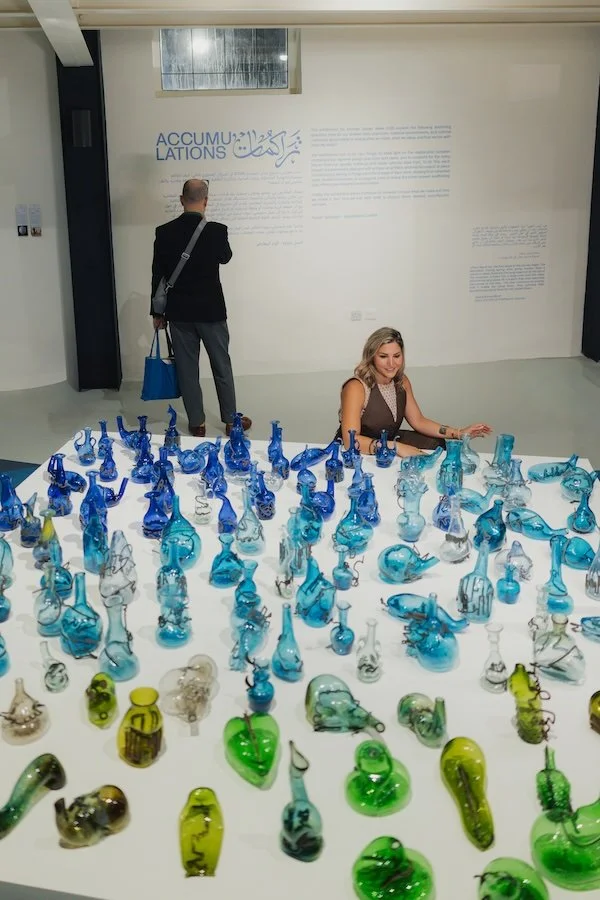
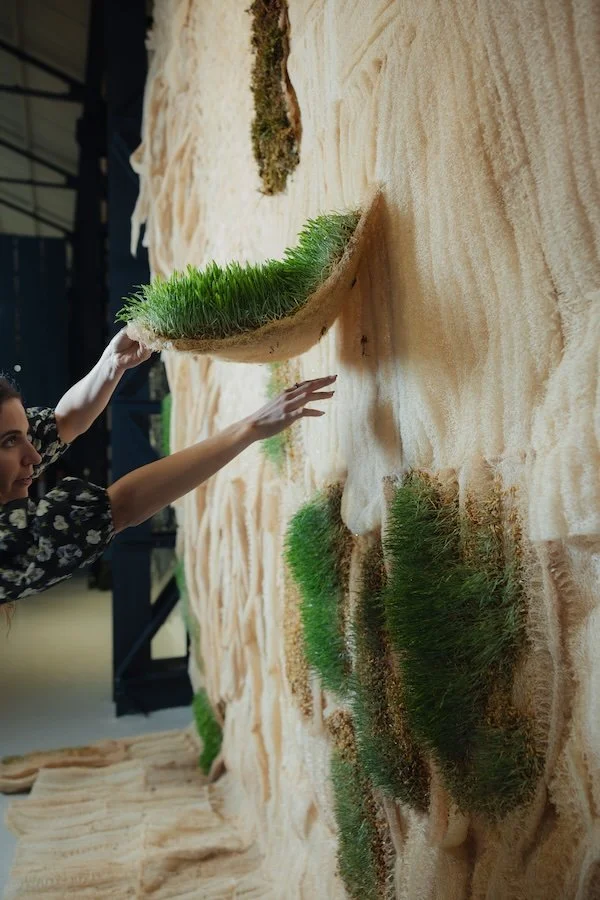
The theme is Accumulations, and it is not about stockpiling objects. The organisers describe it as a reflection on how time, effort and knowledge build up, often unnoticed, into cultural and material potential. They explicitly challenge conventional ideas of wealth, locating true value in human ingenuity, cooperation, heritage and the land itself. The directors put it more simply: it is about what builds up quietly, such as learning, repair habits, materials and relationships, and not about the idea that more is better. The theme also explains the long gap. In their account, designers, makers and students kept working throughout the dormant years, and the edition’s job is to give that work a stage.
Inside the Hangar
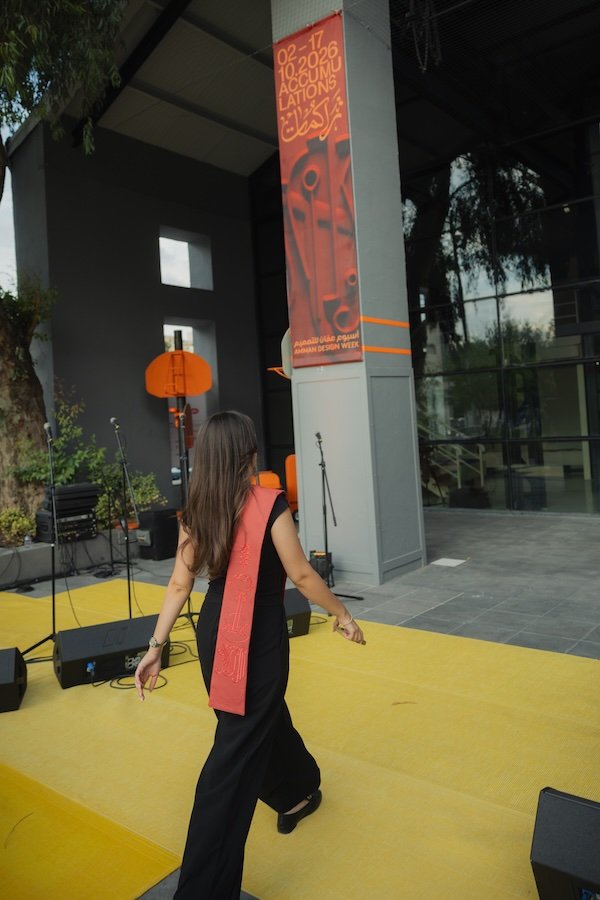
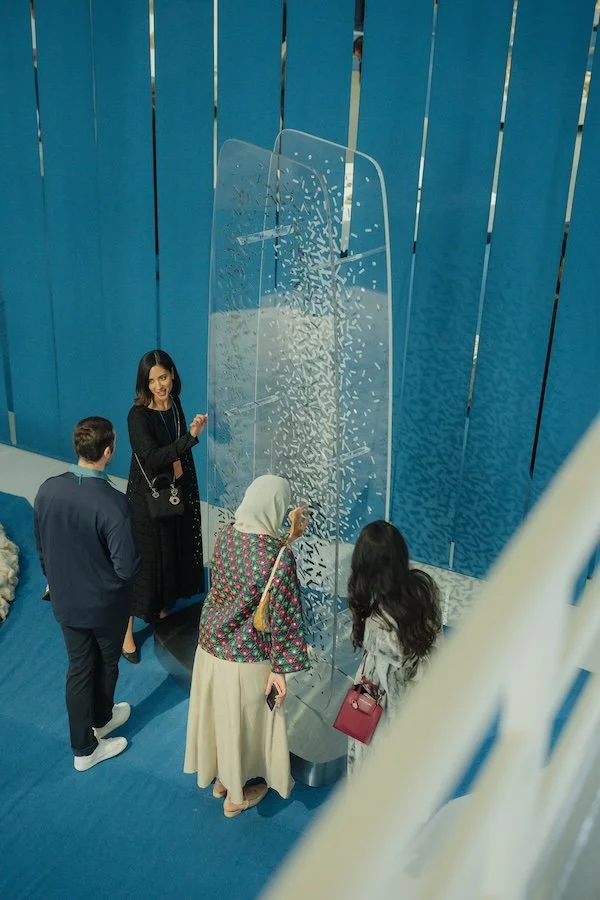
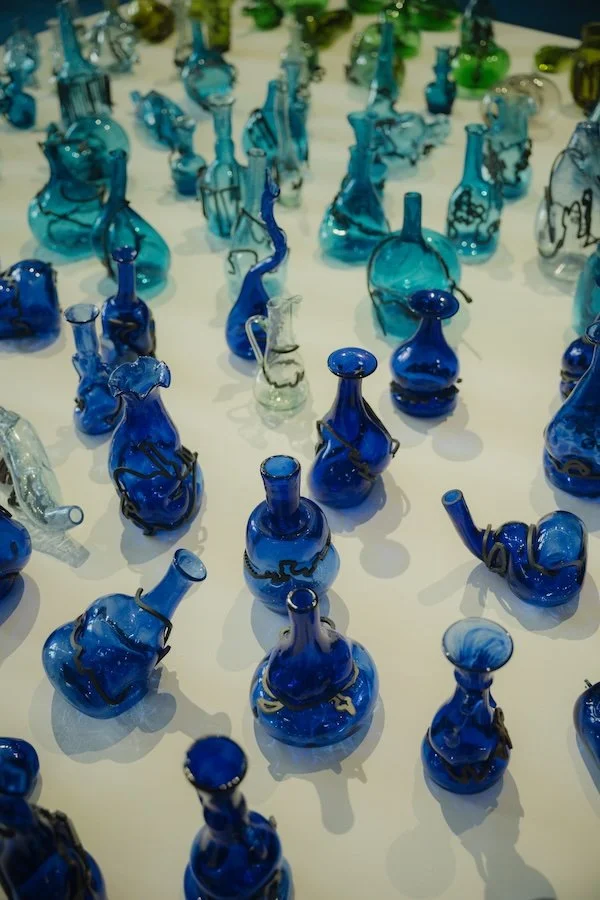
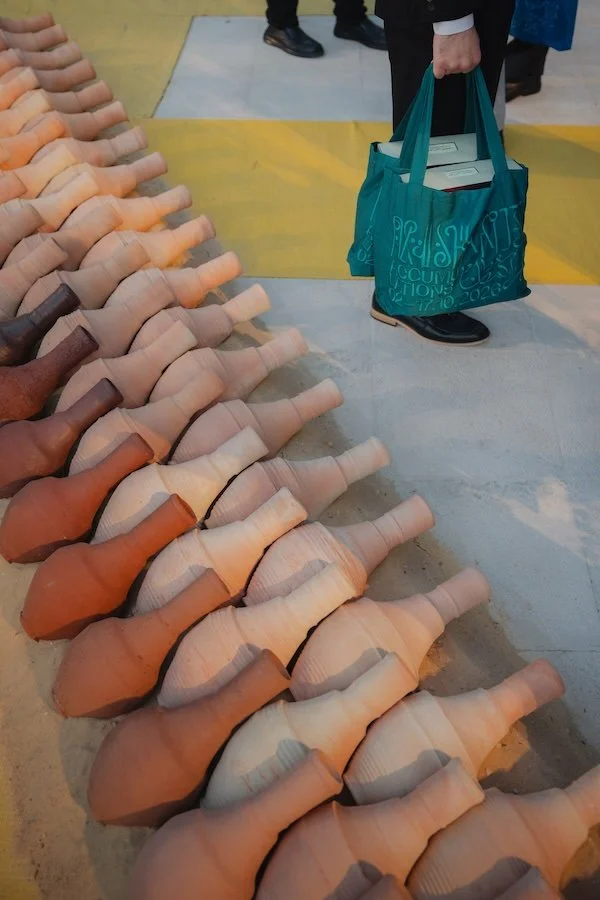
The Hangar remains the centre of the festival. It was built in the 1930s to house Amman’s electricity generators and was later converted into a cultural venue by the Greater Amman Municipality with TURATH Architecture. The man behind TURATH, Rami Farouk Daher, is among this year’s exhibitors, so the building now houses work by the architect who helped save it.
Faysal Tabbarah’s exhibition brings together around seventy designers, studios and collectives. I was struck by how much of the festival’s own history is in the room. Abeer Seikaly, one of Amman Design Week’s founding directors, returns as an exhibitor. Sahel Alhiyari, who curated the very first Hangar exhibition in 2016, is back on the other side of the curatorial line. Ishraq Zraikat and Hadeel Ayed Mohammad both exhibited in 2019 as well. Ammar Khammash, whose work ranges from the Darat al Funun building to the design of Jordan’s banknotes, adds the authority of a senior figure. The Amman studio Naqsh Collective shows how far the local scene has travelled since the last edition.
The list also reaches well beyond Jordan’s borders. Turquoise Mountain brings its long commitment to reviving traditional crafts. AAU Anastas, the Bethlehem architects, appear in collaboration with Kayfa ta. SPOCs for Gaza Design Studio is present too, and its inclusion says a great deal about what this edition believes design can do. Alongside them are dozens of younger names I had not encountered before, and that is precisely the point. A festival about what has been quietly building up should introduce voices we have not yet heard.
Across the city
More than 220 designers, makers and collectives are taking part, across Ras El Ain, Jabal Al Lweibdeh, Jabal Amman, Iraq Al Amir and, for the first time, Aqaba. The venue that surprised me most was Darat Abu Adnan. It is a 1950s house in Jabal Al Lweibdeh, restored for this edition, and the programme uses its kitchen, salon and balcony to ask how a home holds the values of the people who live in it. At Iraq Al Amir, on Amman’s rural edge, the exhibition sits beside Qasr Al Abd, a site with centuries of archaeology. The festival will also leave something behind: four permanent urban interventions will remain in the city after it closes. Visitors are also invited to handle, sit on and use many of the exhibited pieces, so this is not a look-don’t-touch show.
Al-Bashir’s public programme reaches well beyond the exhibition halls. Its talks ask how architectural value is constructed and whether design education prepares students for the world they will work in. Much of the programme was built through workshops held before the opening. Francisco Regalado of LAAA led a two-week intensive on rebuilding heritage through research, digital tools and experimental fabrication. Leen Alfatafta and Lina Khalid of Darkroom Amman, with Hannin Alnimri of makāna, led Tracing Amman, an analogue photowalk and image-making workshop. Ishraq Zraikat facilitated Touch, an experimental weaving residency. The next generation is also well represented. From 203 applications across more than 88 institutions, 37 projects by 47 students were selected for the mentorship programme.
An opening worth the wait
I had the privilege of attending the opening ceremony in the presence of Her Majesty Queen Rania Al Abdullah, who has supported Amman Design Week from the very beginning. The platform was founded under her patronage in 2016, and seeing her there for its return felt like a promise kept.
Beyond Jordan
What moves me most is what the festival represents for the region. The directors say they want Amman Design Week to be a place the region looks to, as people already look to Amman for film and food. That ambition matters well beyond Jordan’s borders. For Syria next door, rebuilding homes and cities also means rebuilding the craft, knowledge and confidence to make things. A theme about repair, inheritance and patient work resonates there, as does having a curator born in Aleppo and a workshop devoted to rebuilding heritage.
For Palestine, the resonance runs deeper still. Palestinian makers, embroiderers and architects have shaped Amman’s design culture for generations, and that bond is visible in the Hangar this year. AAU Anastas bring their Bethlehem practice to the show, and SPOCs for Gaza Design Studio gives Gaza a place in the programme at a time when so much there has been lost. Design cannot rebuild a home on its own, but it can keep alive the knowledge of how to make one.
Seven years is a long time to be quiet. Amman has used it well.