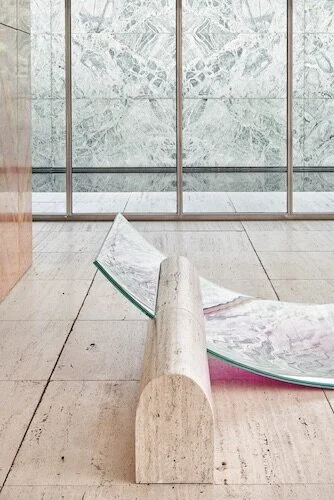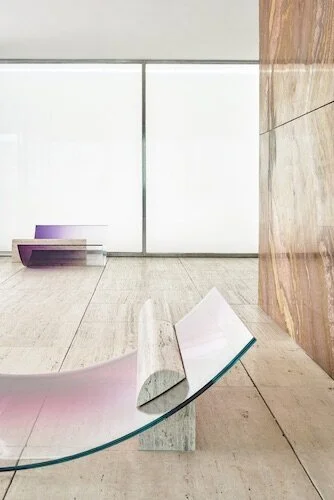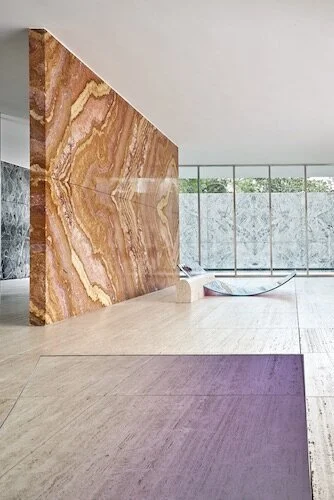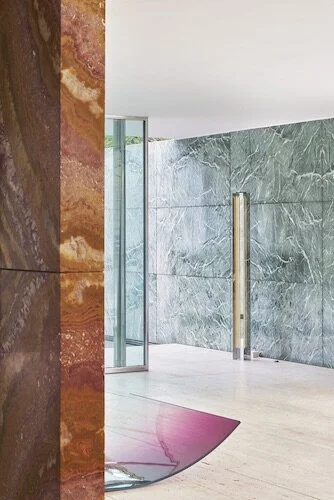
‘NO FEAR OF GLASS’ is the first institutional solo show of all new unique works by Sabine Marcelis. It is also be the first time Fundació Mies van der Rohe has opened its doors to a designer to stage an intervention.
The Fundació Mies van der Rohe and Side Gallery present ‘No Fear of Glass’, the site-specific intervention by Dutch designer Sabine Marcelis in the Mies van der Rohe Pavilion. Taking the title from ‘Fear of glass’, the book about Barcelona Pavilion by Josep Quetglas, the proposal seeks to explore the contrast between the request made to Mies van der Rohe to “not use too much glass” with the creative proposal of Sabine Marcelis herself, where glass is the key element, pushing the material's limits to the end.
Sabine Marcelis has used the opportunity to explore how the design ideals and materiality with which the pavilion has been constructed can be translated into the creation of functional furniture pieces.
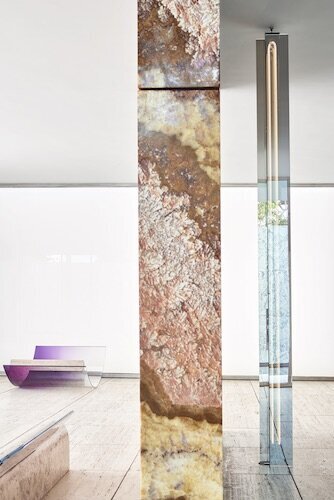
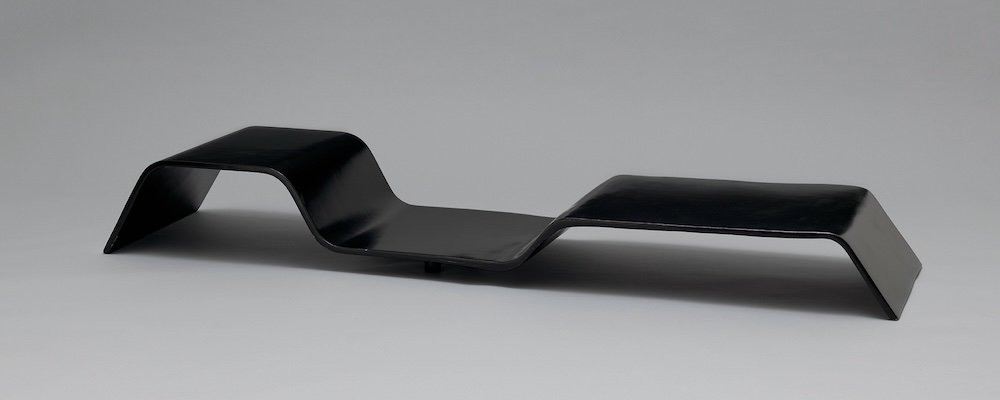
Mies Van de Rohe and Lilly Reich experimented with materials to test their ideals of modernity through the rigour of their geometry, the precision of their pieces and the clarity of their assembly. Marcelis alike uses material and production experimentation to create surprising applications, perfect in form, that translate the materiality and profile of the Pavilion. The exhibited pieces seem to be grown and extruded from the architecture itself; two large chaise longues which are pulled up from the ground by extending the travertine floor to form a base are sliced by a singular sheet of curved glass which is seamingly pulled from the walls. The two materials meet to become sculptural yet functional furniture pieces.
8 chrome columns provide the structural support for the roof of the pavilion. Marcelis introduces a 9th mirrored-glass column which functions as a light and is placed in line with the structural columns, blending in seemlessly with the architecture, both in form and materiality.
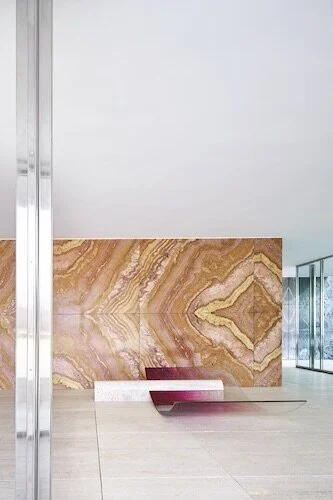
Not only the solid architectural materials are extruded to become new objects however, also the natural elements which are part of the pavilion’s design. The most impressive piece of the intervention is placed in the water pond outside. A curved glass fountain which seems to be bending the water upwards from the ground, and letting it spill over and back down.
Proportions are all strictly linked to those of the pavilion, carefully blending the works into their setting.
“The work of Sabine Marcelis defies fixed definitions. What at first glance looks like a purely aesthetic exercise is actually the output of a scientific and systematic research into production processes. The act of design in her practice becomes a different story, one where light, colour, reflection, strength and curvature are the driving categories of research that is not limited to form and geometry, and that transcends the scale of objects as we know it.
Sabine Marcelis meets Mies Van Der Rohe in one of his most iconic and exemplary spaces. She has looked at the Barcelona Pavilion’s materials – glass, travertine and chrome – with intelligence, to design a series of new pieces that seem to emerge from the architecture itself. These are not just extrusions of existing elements; they rather act as subtle agitations, interfering gently with the cartesian order of the Pavilion.” Ippolito Pestellini, partner OMA/AMO
Mies van der Rohe used material as an experiment to test his design ideals, Marcelis uses material experimentation to push production limits and create new and surprising application.
NO FEAR OF GLASS is presented in the iconic pavilion until January 12th, 2020.
The exhibition is accompanied by a book of the same title with introductions and texts by Ippolito Pestellini Laparelli, Partner at OMA and Anna Puigjaner, co-founder of MAIO architects.
After seven years of silence, Jordan’s design week has reopened under new directors Bisher Tabbaa and Sarah Hejazin and curators Faysal Tabbarah and Khaled Al-Bashir, with a theme that fits its long pause.
Mexico's first biodesign exhibition, at the Museo Franz Mayer, treats plants, fungi and microbes not as raw material but as fellow designers, and asks us to take a humbler seat at the workbench.
A desert exhibition lands in the heart of the Marais this September, as AlUla and Lafayette Anticipations pair centuries of Saudi craft with contemporary French collecting, proof that sand and concrete have more in common than the map suggests.
The firm that built M+ hands over its sketchbooks. Discretion, it turns out, was never the point.
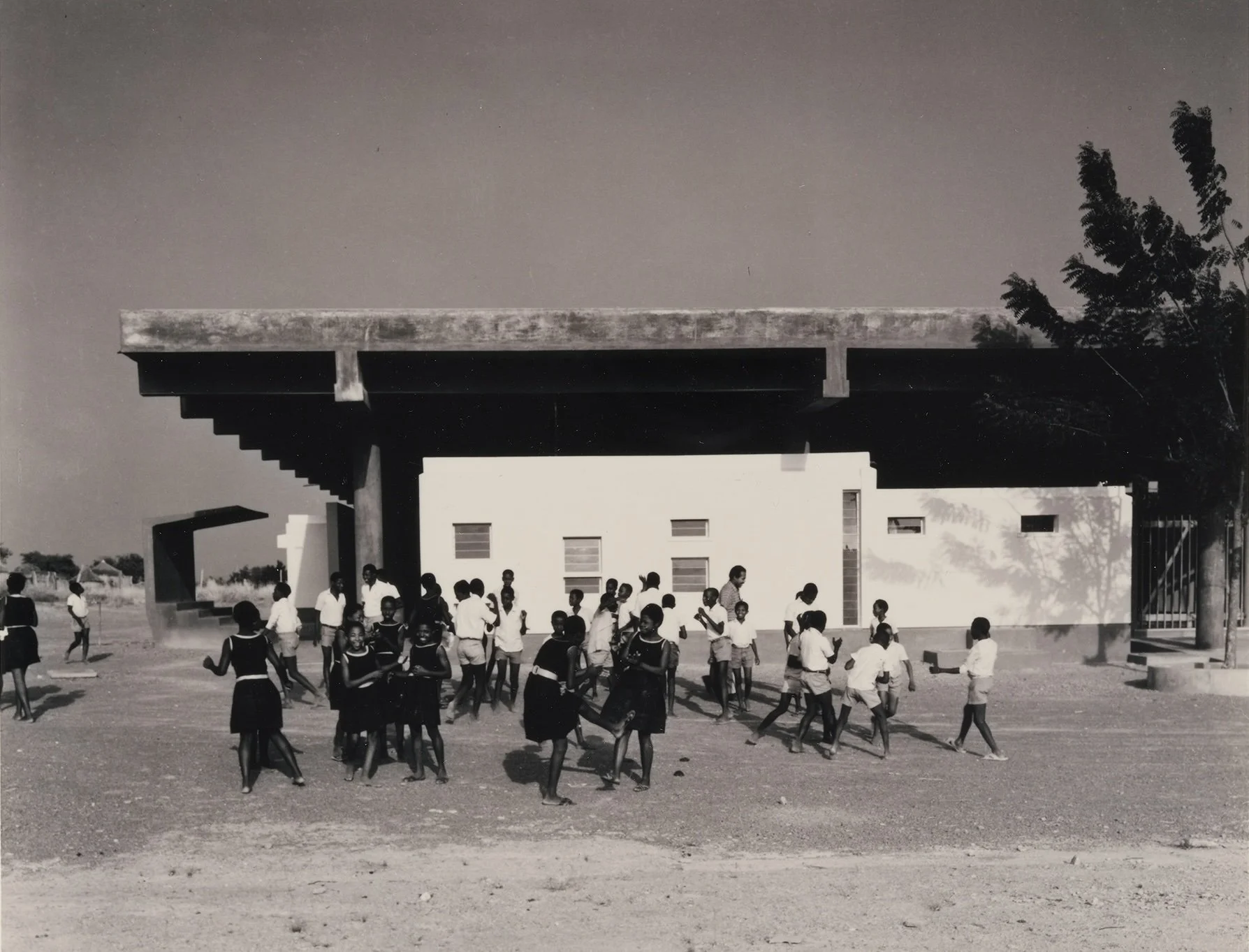
Concrete convictions: how seven newly independent nations built their identity in glass and reinforced concrete — and why MoMA's latest show could not have landed at a more Instagram-ready moment.
The Italian who made the design world uncomfortable… and then indispensable, finally gets his Tokyo moment.
Hella Jongerius doesn’t just make beautiful things—she makes you think differently about them. This spring, the Vitra Design Museum argues for her as one of the most influential design minds of our era.
Patricia Urquiola’s exhibition at the Centre for Innovation and Design at Grand-Hornu arrives at a moment when design can no longer ignore its own implications.
Fungi: Anarchist Designers. A refreshing exhibition that casts fungi not as trendy materials but as autonomous designers with their own unruly logic, far beyond our control at the Nieuwe Instituut, Rotterdam.
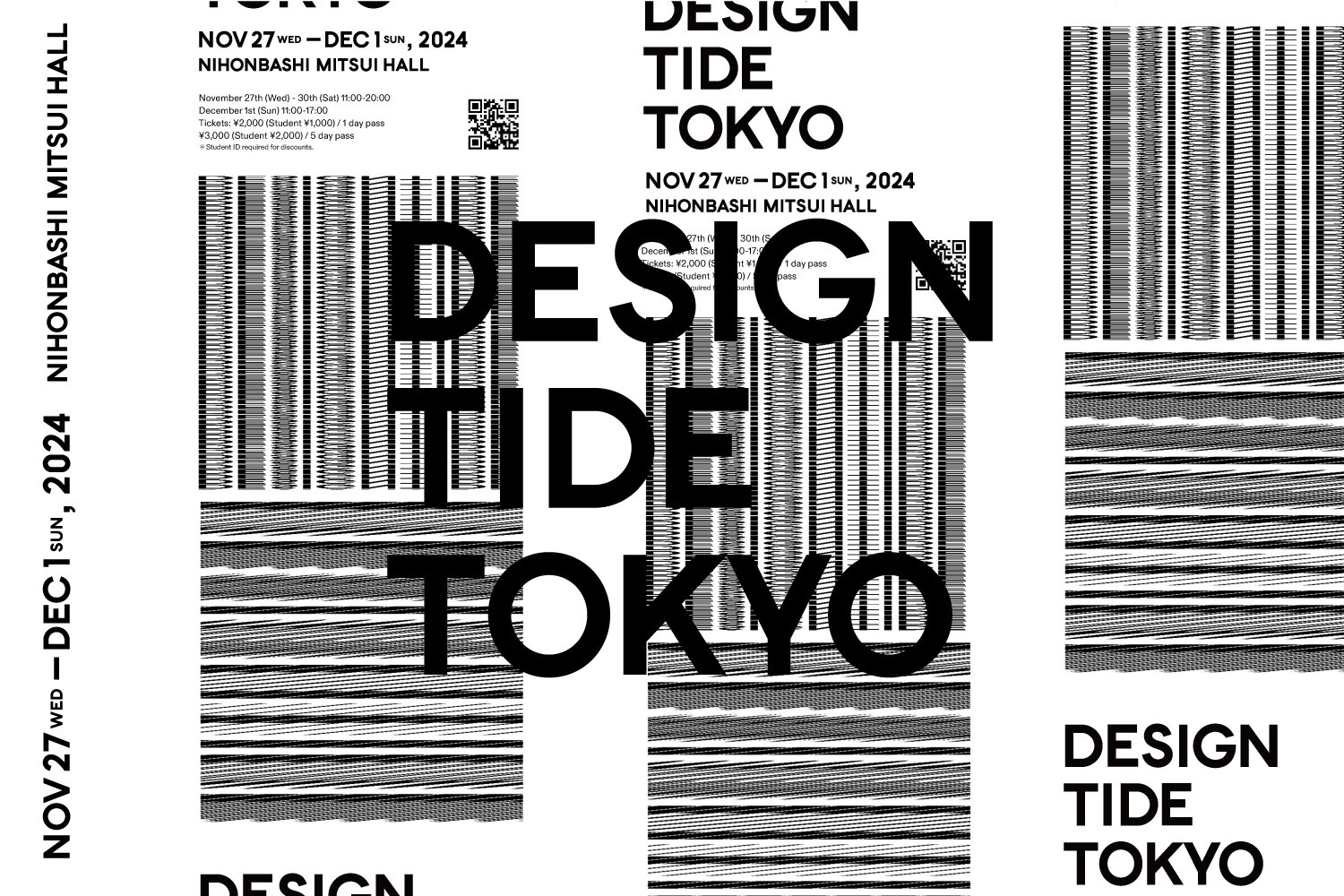
After a hiatus of twelve years, Designtide Tokyo is making its much-anticipated return to the Japanese capital on November 27th, marking an exciting new chapter for design enthusiasts worldwide.
Since its launch in October 2015, Dubai Design Week is set to celebrate a decade next month with one of its largest editions yet. More than 500 designers from 40 countries will gather in the city, showcasing Dubai as the design capital of the Middle East.
The sixth edition of EDIT Napoli is hosting over 100 exhibitors and featuring seven CULT shows at the Archivio di Stato di Napoli.
The Museum of Modern Art presents Crafting Modernity: Design in Latin America, 1940–1980, the first exhibition by a major American museum to examine modern design in the region on a broad scale.
Ever faster, stronger, more beautiful, more intelligent, the cult of individual performance has taken hold in a technological society where the body seems increasingly to be seen as an improvable tool. Can design turn us into superheroes? That is the topic of the brand new exhibition at CID - Le Grand Hornu.
The exhibition at Vitra Design Museum focuses on the transformation of the energy sector from the perspective of design.
On the occasion of the inaugural Design Doha Biennial, an immersive showcase blending Uzbekistan's rich craft tradition with contemporary creativity is on display at M7.
The International African American Museum opens this weekend in Charleston at the waterfront site that served as the port of arrival for nearly half of all enslaved Africans brought to North America in the eighteenth and nineteenth centuries.
On the occasion of the Melbourne Design Week, Tom Fereday and Charlie White present ‘Versa’, an exhibition showcasing a collection of unique furniture and architecture elements.
Few weeks prior to Melbourne Design Week, ‘Export’ is an exhibition focusing on talents from Tasmania, showing the diversity and wealth of the island.
Beside the extensive design offer in town, Tashkent Modernism. Index is an architectural exhibition at Triennale on Soviet Modernist layer of Tashkent, Uzbekistan.
With the ongoing challenges in Lebanon, creating and producing design is a constant struggle. During Salone del Mobile 2023, ‘Under Design Lebanon’ exhibition will present a realistic mapping and projection on the currently still functioning entities.
After its unveiling at the Grand Hornu (Belgium), the Beirut. The Eras of Design exhibition opens at the mudac in Lausanne. A unique and rare chance to learn about the history of design from a country leading in creativity despite its political instability.
In Lille, the first comprehensive retrospective dedicated to Isamu Noguchi offers a rare opportunity to (re)discover the artist’s creations building an intangible bridge between arts and cultures, sculpture and design and also East and West.
#SummerDesignExhibition 2022
Cooper Hewitt - Smithsonian Design Museum presents ‘Designing Peace’, an exhibition exploring the unique role design can play in pursuing peace.
#SummerDesignExhibition 2022
Finland is known for being in the front line of equality, and many of the most iconic Finnish design products were created to increase equality in our daily lives. Helsinki Design Museum’s exhibition takes us on a journey through the ideals of equality in different decades.
#SummerDesignExhibition 2022
Architecture, art and design, Nanda Vigo did it all. With an original scenography in a former prison, the Museum of Decorative Arts and Design of Bordeaux, pays a homage to the unique Italian free spirit.
#SummerDesignExhibition 2022
To mark the 50th anniversary of the 1972 Olympic Games in Munich, Die Neue Sammlung – The Design Museum is highlighting design trends at the Olympics and Paralympics.
Following an invitation from the Vitra Design Museum, Sabine Marcelis has transformed the Schaudepot in one simple, sweeping gesture by sorting its roughly four hundred exhibits by colour.
Despite all possible challenges, Lebanon’s design scene has flourished with a diverse palette of talents. ‘Beirut – Eras of Design’ exhibition portraits the dynamic evolution and growth from 1950s.
On the occasion of the Taiwan Design Expo in Chiayi, six design teams were asked to re-envision public spaces based on water landscapes.